
Project Case Study
Dry H₂S Scavenger
Iron‑oxide–based fixed‑bed adsorbents Technology
Fixed bed adsorbent Scrubbing System
H2S Scavenger capable of scrubbing H2S gas from 1200ppm to 0ppm
High Efficiency
Adsorbents technology removes up to 99% of H2S molecules
Innovative
Insulated skid with electric trace heating ensures reliability in harsh climates and demonstrates commitment to innovation.
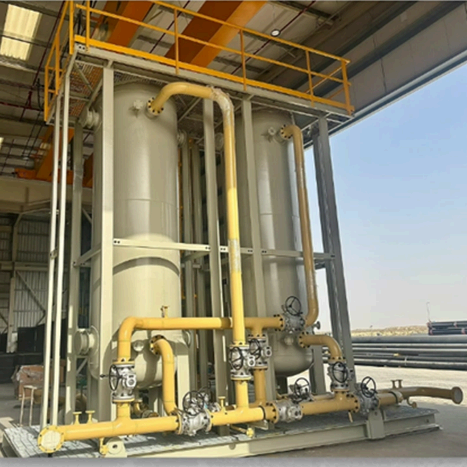
Overview
This case involves a Dry H₂S Scavenger system designed for a scenario where conventional liquid amine or wet scrubbing was not feasible. The client had a gas stream with very high H₂S content (around 1200 ppm) and needed it reduced to 0 ppm (essentially complete removal). The use-case might be a remote site or an operation where handling liquid chemicals was impractical, so Kapwell proposed a dry, fixed-bed adsorption solution. The objective was to create a system that could scrub H₂S out of the gas using solid adsorbents, operate safely in a potentially cold environment, and not require a large continuous supply of chemicals or water.
Solution
Kapwell’s solution was a fixed-bed H₂S adsorber system using iron-oxide–based adsorbent media. The system consists of one or more adsorption vessels filled with pelletized dry adsorbent. As the sour gas passes through these vessels, the iron oxide (often formulated on a solid substrate) reacts with H₂S to form iron sulfide, thereby removing H₂S from the gas. This particular project was capable of scrubbing H₂S from 1200 ppm down to 0 ppm in the outlet gas, effectively eliminating H₂S. Kapwell designed the vessels with appropriate residence time and enough media volume to handle the high inlet concentration and the desired throughput. To ensure reliability in a harsh climate, the skid was equipped with insulation and electric heat tracing. This prevents the adsorbent bed from getting too cold (since adsorption efficiency can drop at low temperatures, and it also avoids any condensation in the vessels). The system included features like inlet distribution for even gas flow through the bed, and easy-loading hatch for replacing spent adsorbent. It was also instrumented to monitor inlet/outlet H₂S levels and differential pressure across the bed, indicating when the media is saturated and needs change-out.
Key
Features
Fixed-Bed Adsorption
Utilizes a dry iron oxide adsorbent bed to chemically capture H₂S. The system can reduce H₂S from 1200 ppm to essentially 0 ppm, yielding completely sweet gas. This fixed-bed approach requires no continuous chemical injection – the media is consumed gradually and replaced after saturation.
High Removal Efficiency
The adsorbent technology provides up to 99% removal of H₂S molecules in each pass. With the design of multiple beds or a deep bed, essentially 100% removal is achieved until the media is near exhaustion. This high efficiency ensures that even extremely sour gas can be made completely H₂S-free, suitable for sensitive downstream uses or emissions.
Insulated & Heat-Traced Skid
The entire adsorber unit is insulated and equipped with electric trace heating. This is an innovative feature ensuring that the adsorption reaction can proceed effectively even in cold ambient conditions – it prevents the formation of liquid water or sulfur that could clog the bed, and keeps the chemical reaction kinetics favorable. It also demonstrates Kapwell’s attention to operational contexts (e.g., outdoor installations in harsh climates).
Low-Operational Complexity
The dry scavenger system operates simply – gas in, gas out – with automatic monitoring. There are no rotating equipment or complex chemical handling systems. Once loaded, the adsorbent bed works autonomously, and replacement of media is the main operational task. The design includes quick-opening manways and possibly cartridge-style media containment for easier replacement, minimizing downtime when changing out spent adsorbent.
Challenges & Innovation
The challenge here was twofold: achieving complete H₂S removal at very high inlet concentrations, and doing so without the aid of liquid reagents or continuous processes. The innovation came in the form of optimizing the adsorbent usage – Kapwell selected a high-capacity iron oxide media and designed the bed depth and flow rate to ensure full H₂S removal (with some safety margin) before breakthrough. This often meant using multiple vessels in series or a single tall vessel with staged loading. Another challenge was the environmental condition – if the installation is in a cold or variable climate, dry systems can suffer if not managed (for instance, iron oxide reaction is exothermic, but if the gas is very cold or if there’s any moisture, it can slow the reaction). Kapwell’s insulation and heating solution was an innovative way to keep conditions optimal inside the vessel. Additionally, to handle such a high H₂S content safely, Kapwell had to innovate on materials (ensuring the vessel and seals are compatible with sulfur formation) and on safety features (H₂S detectors around the skid, proper venting in case of upset, etc.). The project showcases innovation in using dry adsorption as a standalone solution where normally a more complex amine plant might be considered.
Client Benefit
Complete H₂S Removal
The client achieves 0 ppm H₂S in the treated gas, which means absolutely no odor or corrosion potential from H₂S remains. This allows the gas to meet even the strictest requirements (for example, for pipeline gas which often needs <4 ppm or for usage in processes that cannot tolerate sulfur).
Simplified Operation
The dry scavenger system is much simpler to operate than liquid-based systems. The client benefits from low manpower requirements – no constant chemical injections to adjust or liquid waste to dispose of. They only need to monitor bed life and replace the adsorbent periodically. This simplicity reduces the chance of operational error and lowers OPEX.
Safer and Environmentally Friendly
Iron oxide beds produce solid sulfur by-products (iron sulfide) that can be handled and disposed of in a controlled way, unlike liquid amine plants that produce H₂S-rich waste streams requiring flaring or sulfur recovery. This makes the solution more environmentally friendly for the scale, and from a safety perspective, it avoids handling toxic H₂S in liquid form. Also, by eliminating H₂S, the workplace is safer for personnel (no toxic gas risk in normal operation).
Flexible Deployment
The skid can be deployed in remote or off-grid locations since it doesn’t rely on large utilities (just some power for instruments and heaters). The robust design (with heating and insulation) means it works in extreme climates, providing the client with a flexible solution for various sites including those where water-based processes would freeze or where water is scarce.
Longevity of Equipment
By removing H₂S entirely, the client protects all downstream equipment and pipelines from sulfidation corrosion, dramatically extending their life. This can result in significant cost savings in the long term, as the integrity of the infrastructure is maintained.
Timeline
Delivered on schedule. (Exact weeks not specified.) Kapwell delivered the dry H₂S scavenger unit within the agreed project timeframe, aligning with the client’s requirement for rapid implementation. The timeline was met by efficient design and assembly, and the unit was ready for operation as soon as it arrived on site.