
Project Case Study
Mud Gas Separator
Oil and Gas- Middle East
Mud Gas Separator
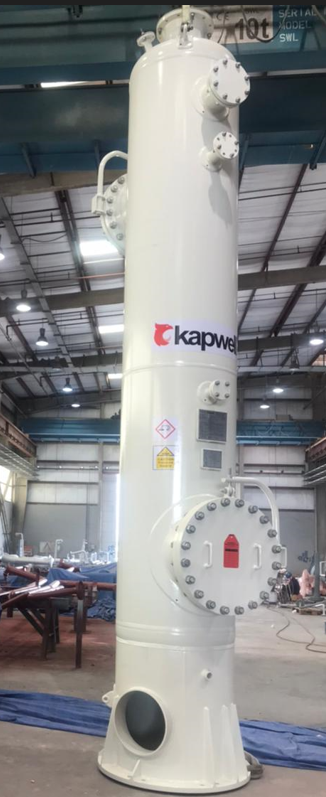
A compact vertical treatment unit integrating high-efficiency separation and adsorption technology within a minimal footprint..
Certified & High Capacity
CE/UKCA & ATEX certified; processes for safe and efficient Oil and Gas testing and management.
Delivered in 28 Weeks
Strict timeline met by collaborating with suppliers to tailor equipment and integrate with existing infrastructure.
Overview
Kapwell was tasked to design a Mud Gas Separator for an oil and gas drilling operation in the Middle East. In drilling rigs, a mud gas separator (also known as a “poor boy degasser”) is critical for safely handling drilling mud returns that carry entrained gas, especially during a kick or well control situation. The objective was to provide a compact vertical separator that could remove gas from the drilling mud and do so safely even if the gas contained hazardous components like H₂S. The client needed a unit that would fit on their rig, handle the expected mud and gas volumes, and enhance safety by possibly treating the separated gas (since H₂S was a concern in this region).
Solution
Kapwell delivered a vertical high-efficiency mud gas separator designed to separate and vent gas from drilling mud while returning degassed mud back to the mud system. The unit is a vertical cylindrical vessel where mud is fed in and directed against baffles; this allows gas to break out of the mud due to the sudden reduction in pressure and flow turbulence. The separated gas rises to the top and is safely vented or flared, while the mud falls to the bottom and is routed to mud tanks. What makes this Kapwell design stand out is the integration of an adsorption technology within the separator[35]. Specifically, the separator includes an internal section (or a downstream attachment) with adsorbent material to scrub H₂S out of the vented gas. In essence, it not only separates the gas but also treats it by removing toxic H₂S before the gas is released, significantly improving safety on the rig. The separator was compact, with a minimal footprint, to suit the space constraints of a rig floor or skid. It was built to handle the anticipated flow rates of mud and gas during a well control event. The design also featured pressure relief and an emergency vent line, ensuring it could handle an influx (surge) of gas without over-pressurization.
Key
Features
High-Efficiency Gas Separation
The mud gas separator uses an internal baffle and flow distribution system to ensure effective separation of gas from drilling mud. It’s capable of handling large gas volumes suddenly coming out of solution. This prevents dangerous gas build-up in the mud system and allows for controlled venting.
Integrated H₂S Scavenging
Uniquely, the Kapwell design incorporates H₂S adsorbent material within the gas vent path. As gas is separated and travels to the vent line, it passes through this adsorption section which scrubs out H₂S, reducing a high inlet H₂S concentration (common in some Middle East fields) to safer levels. This feature greatly enhances safety by ensuring the gas vented or flared has minimal H₂S, protecting personnel and equipment from sulfur exposure.
CE/UKCA & ATEX Certified Construction
The separator is CE/UKCA marked and ATEX certified, meaning it meets European standards for pressure vessels and is suitable for use in explosive atmospheres. The robust construction can handle the pressures of a kick and the sour nature of the gas. All materials were chosen for compatibility with corrosive H₂S and the abrasive drilling mud (e.g., stainless steel internals or special coatings to resist sour service).
Compact Footprint with Easy Installation
The vertical separator was designed to be skid-mounted and compact, allowing it to be installed on the rig without major modifications. It has lifting lugs and a skid base for quick rig-up. The minimal footprint design[36] is ideal for space-limited environments like drilling rigs. Additionally, it includes quick-connect fittings for gas vent and mud return lines to simplify deployment.
Challenges & Innovation
One challenge was to ensure the separator could handle emergency situations (kicks) where gas volumes are high, without being oversized and unwieldy for the rig. Kapwell tackled this by optimizing the internal baffles and using computational modeling to verify that even at peak gas flow, the separator would vent gas efficiently without letting it carry over into the mud outlet. The innovation of adding an H₂S scavenging feature is particularly noteworthy – mud gas separators traditionally just vent gas to a flare or atmosphere, but by adding H₂S adsorption, Kapwell created a hybrid device that separates and treats the gas simultaneously. This required innovation in how and where to place the adsorbent so as not to impede the separator’s primary function. Another challenge was making the unit small enough for a rig but still effective; Kapwell’s experience with compact separation equipment and high-efficiency internals enabled a solution that meets both size and performance requirements. Ensuring safety and compliance was also critical – the presence of H₂S means everything from material selection to vent design needed careful attention (for instance, including a failsafe in case the adsorbent section saturates or in case of an exceptionally large gas surge). The delivered solution showcases innovation in improving a standard oilfield safety device (the poor boy degasser) by incorporating gas treatment capability.
Client Benefit
Enhanced Safety during Drilling
The primary benefit is significantly improved safety. The mud gas separator prevents hazardous gas from staying in the mud system, and by scrubbing H₂S, it ensures that even the vented gas is less toxic. This protects rig personnel from H₂S exposure and reduces the risk of a dangerous gas release. In well control scenarios, this piece of equipment is critical for safely handling the situation.
Regulatory Compliance
If venting or flaring gas, having H₂S removed helps meet environmental and regulatory standards (since H₂S emissions are heavily regulated). The client can be confident that their drilling operation adheres to air quality regulations and occupational safety limits.
Preservation of Mud Quality
By efficiently separating gas, the separator prevents gas from disrupting the drilling mud properties. The degassed mud returns to the active system without foaming or excessive gassing, meaning the mud maintains its weight and rheology, which is important for well control. This helps the drilling operation proceed smoothly after a gas influx is managed.
Compact and Deployable
The client benefits from a portable, rig-ready design. The separator can be moved from one site to another and set up quickly, which is valuable for drilling contractors or operators with multiple rigs. Its compactness saved the client rig modifications and space, which in drilling terms can also be a cost saving (every square foot on a rig is at a premium).
On-Time Delivery for Drilling Schedule
Kapwell delivered the unit in 28 weeks[38], fitting within the client’s project timeline (which likely was tied to a drilling schedule). Having the separator ready and on-site as drilling commenced meant no delays in operations and assurance that the safety equipment was in place from the start.
Timeline
Delivered in 28 weeks. The mud gas separator, with its integrated scavenger system, was completed and delivered in roughly 7 months. This timely delivery ensured that the equipment was ready ahead of the client’s critical drilling operations. Kapwell’s on-time execution allowed the client to proceed with drilling as planned, with all necessary safety systems in place.