
Project Case Study
Sand Jetting System for Oil & Gas Separators
Oil and Gas
Sand Jetting
Remove deposits of solids or sand inside horizontal and vertical vessels. These systems “fluidise” the solids with pressurised water injected using spray nozzles.
Certified & High Capacity
CE/UKCA & ATEX certified; processes for safe and efficient Oil and Gas testing and management.
Overview
The Sand Management case study pertains to a solution Kapwell provided for an oil and gas production facility experiencing sand accumulation in their separators. Sand produced from wells tends to settle in separators and other vessels, gradually leading to reduced capacity, blockages, and potential erosion issues. The client’s goal was to implement an in-situ sand removal system that could periodically clear out sand deposits without needing to shut down and manually clean the vessels. Kapwell was tasked with designing a system that could be retrofitted into existing horizontal and vertical separators to fluidize and remove settled sand on demand.
Solution
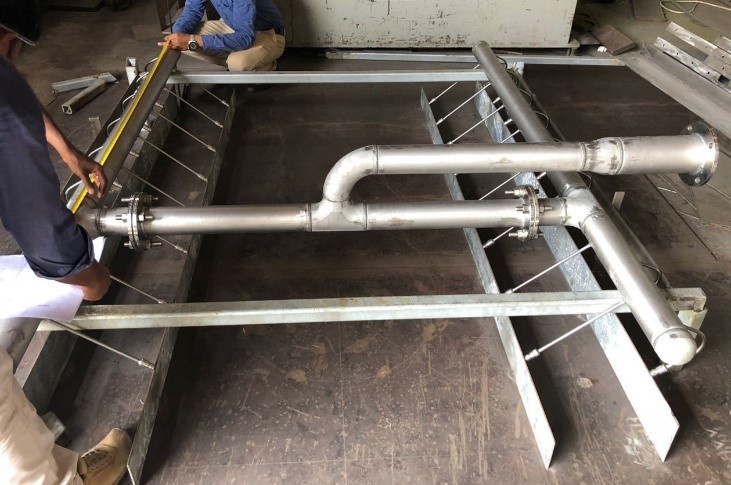
Kapwell’s solution was a sand jetting system installed inside the separators. This system comprises a network of spray nozzles strategically placed along the vessel’s interior, particularly in areas where sand tends to accumulate (e.g., at the bottom of horizontal separators or in sump sections of vertical separators). During operation, pressurized water is injected through these nozzles, which “fluidizes” the settled sand, basically stirring it up into a slurry. The slurry of sand and water is then drained or jetted out through dedicated outlets to a collection or disposal system. Kapwell engineered the nozzle layout and the water injection pressure to ensure that all portions of the vessel would be reached by the jets – even corners and low-flow zones. Check valves and strainers were included to prevent backflow of process fluids into the water lines. The system was designed to be actuated periodically (either manually or automatically) so that sand does not get a chance to significantly build up. Importantly, all components (nozzles, piping) are made from erosion-resistant materials due to the abrasive nature of sand. The design also took into account that it should not interfere with normal separator operation when not in use.
Key
Features
Internal Jet Nozzles
The key feature is a series of internal sand jet nozzles that can cover the entire vessel floor area. These nozzles are positioned and angled based on flow simulations to create overlapping jets that sweep the sand towards the vessel’s drain points. They are made of hardened material to resist wear.
On-Demand Sand Fluidization
The system can be activated as needed (e.g., on a schedule or when separators show signs of sand buildup). By injecting water at high pressure, the system fluidises the settled solids, effectively turning a pile of sand into a flowable slurry. This allows sand removal without opening the vessel.
Certified & Safe Integration
The sand management modification was done in line with CE/UKCA and ATEX standards. All penetrations into the vessel were properly reinforced and certified so as not to compromise pressure integrity. The materials and instruments (like the actuated valves for water injection) are suitable for hazardous areas, ensuring the safety and compliance of the upgraded separator.
Minimal Process Disruption
The system was designed such that sand jetting can occur either while the unit is off line or even online at reduced rates (depending on the operator’s preference), meaning maintenance shutdown frequency is reduced. The nozzles are low-profile and don’t obstruct normal separation. When not in use, the water line is isolated so it doesn’t affect the process.
Challenges & Innovation
One major challenge was to ensure the entire sand bed could be cleared and not just parts of it. Kapwell tackled this by using computational fluid dynamics (CFD) to model water jet coverage and sand suspension. The result was an innovative nozzle placement strategy that ensures comprehensive coverage within both horizontal and vertical vessels. Another challenge was dealing with the erosion potential of high-pressure sand slurry. Kapwell’s innovation here was to use erosion-resistant design principles: for example, lining areas near the nozzles with wear pads, using special nozzle materials, and routing the sand slurry out through piping designed to handle abrasion. The system also had to be designed for easy retrofit, meaning installation had to be feasible through existing manways or minor vessel modifications. Kapwell came up with modular nozzle headers that could be inserted into vessels without needing to cut them open entirely, an innovation that kept retrofit time and cost low. Overall, the solution demonstrates innovation in combining fluid dynamics and practical engineering to solve a persistent maintenance problem in a clever way.
Client Benefit
Reduced Maintenance Downtime
The client no longer needs to open vessels for manual sand clean-out as frequently. Previously, sand removal might have required a shutdown and human entry to shovel or vacuum out sand. With the Kapwell sand jetting system, this can be done by simply operating the system, which can often be done during a routine maintenance flush or minor slowdown. This significantly cuts downtime and maintenance costs.
Sustained Separator Performance
By regularly clearing out sand, the separators maintain their design capacity and efficiency. Sand buildup can reduce the effective volume for separation and cause turbulence; removing it means the separators function as intended, thus the client sees more consistent separation performance and less risk of process upsets.
Longevity of Equipment
Proactive sand removal prevents the erosive damage that a static sand bed can cause (for instance, if sand accumulates and then gets carried on in slugs, it can erode outlets and valves). By fluidizing and washing it out gently, the system minimizes wear on the vessel and exit piping. This can extend the life of expensive separators and associated equipment.
Improved Safety
Not having to send personnel inside a vessel full of potentially hazardous materials (oil, H₂S, etc., plus sand) is a safety win. The automated in-situ cleaning means fewer confined space entries and less exposure of workers to hazardous conditions. When manual cleaning is needed, the sand quantities are much smaller, making the environment safer and the task shorter.
Operational Flexibility
The client can schedule sand removal at optimal times (e.g., when moving between well flows or during low production periods) with a simple operation of the jetting system. This flexibility means sand management is no longer a major operational hindrance but rather a routine task. It ultimately leads to more continuous production and fewer unplanned halts due to separator issues.
Timeline
Integrated as per schedule. The sand jetting system was installed in the client’s separators during a planned maintenance period. Kapwell coordinated the fabrication of nozzle assemblies and had them ready to install, so the retrofit was completed on time. Once in operation, the system immediately started preventing sand build-up, and the client observed the benefits in the next operating cycle. (The exact project timeline was aligned with the facility’s maintenance schedule and was completed within that window.)